Schools ask students to learn. But sometimes, the social environment around learning quietly rewards them for pretending not to care.
We usually think about learning as an individual process.
A student pays attention, studies, practices, makes mistakes, receives feedback and gradually improves.
But there is another system operating in almost every classroom.
The social system.
Students are not only asking themselves:
“Can I do this?”
They may also be asking:
“What will happen socially if I show that I care about this?”
And sometimes, that second question becomes more powerful than the first.
The strange social risk of trying
Imagine a student who knows the answer to a teacher's question.
They could raise their hand.
But they don't.
Not because they are unsure.
Because raising their hand communicates something to the rest of the class.
I know this.
I was paying attention.
I care.
In a healthy learning culture, none of those statements should be dangerous.
But in some peer groups, visible effort carries a social cost.
The student who answers every question may become “the smart one.”
The student who studies may become “the nerd.”
The student who takes an assignment seriously may be mocked by classmates who perform indifference.
So students learn something that was never written in the curriculum:
Sometimes it is socially safer not to look like you are trying.
That changes everything.
“I didn't even study”
There is a revealing sentence heard constantly around schools:
“I didn't even study.”
At first, it sounds like a meaningless comment.
But think about what it accomplishes.
If the student gets a good grade, they can appear naturally intelligent.
If they get a bad grade, they have an explanation.
They didn't fail after trying.
They simply didn't try.
Effort has been removed from the equation.
And that protects something important: identity.
Trying seriously creates vulnerability.
If I genuinely try and fail, perhaps I am not as capable as I hoped.
If I never really try, failure proves almost nothing.
This creates a powerful psychological escape route:
“I could have done better if I had actually tried.”
Unfortunately, learning requires exactly what this strategy avoids.
- Effort.
- Mistakes.
- Repetition.
- Feedback.
- And the willingness to temporarily be bad at something.
Humor can become armor
Humor is one of the most interesting ways students manage this tension.
Humor itself is not the problem. A funny classroom can be a fantastic learning environment.
But humor can also become armor.
A difficult assignment appears.
Someone makes a joke.
The group laughs.
The seriousness of the situation disappears.
Now the student can participate without fully exposing themselves to the possibility of failure.
The message becomes:
“I'm doing this, but don't worry — I'm not taking it too seriously.”
This creates distance between the student and the task.
If they fail, the failure doesn't fully count.
They were joking.
They weren't really trying.
They didn't care anyway.
The behavior can look like laziness from the outside.
Sometimes it is.
But sometimes it is something more complicated:
social self-protection.
The classroom contains two incentive systems
This exposes a deeper problem in education.
Schools have an official incentive system.
It says:
- Learn.
- Ask questions.
- Be curious.
- Practice.
- Make mistakes.
- Improve.
But students also operate inside an unofficial social incentive system.
That system can sometimes say:
- Don't try too hard.
- Don't look too interested.
- Don't ask something stupid.
- Don't make yourself stand out.
- Don't show that you don't understand.
- Don't look like you care more than everyone else.
And when these two systems conflict, we should not automatically assume that the official system wins.
For a teenager, social belonging can be enormously important.
The approval of classmates is immediate.
The benefits of education may be years away.
From the student's perspective, protecting social status can therefore be perfectly rational in the short term — even when it damages learning in the long term.
This can create a dangerous feedback loop
The consequences do not necessarily end with one joke or one unanswered question.
A pattern can develop.
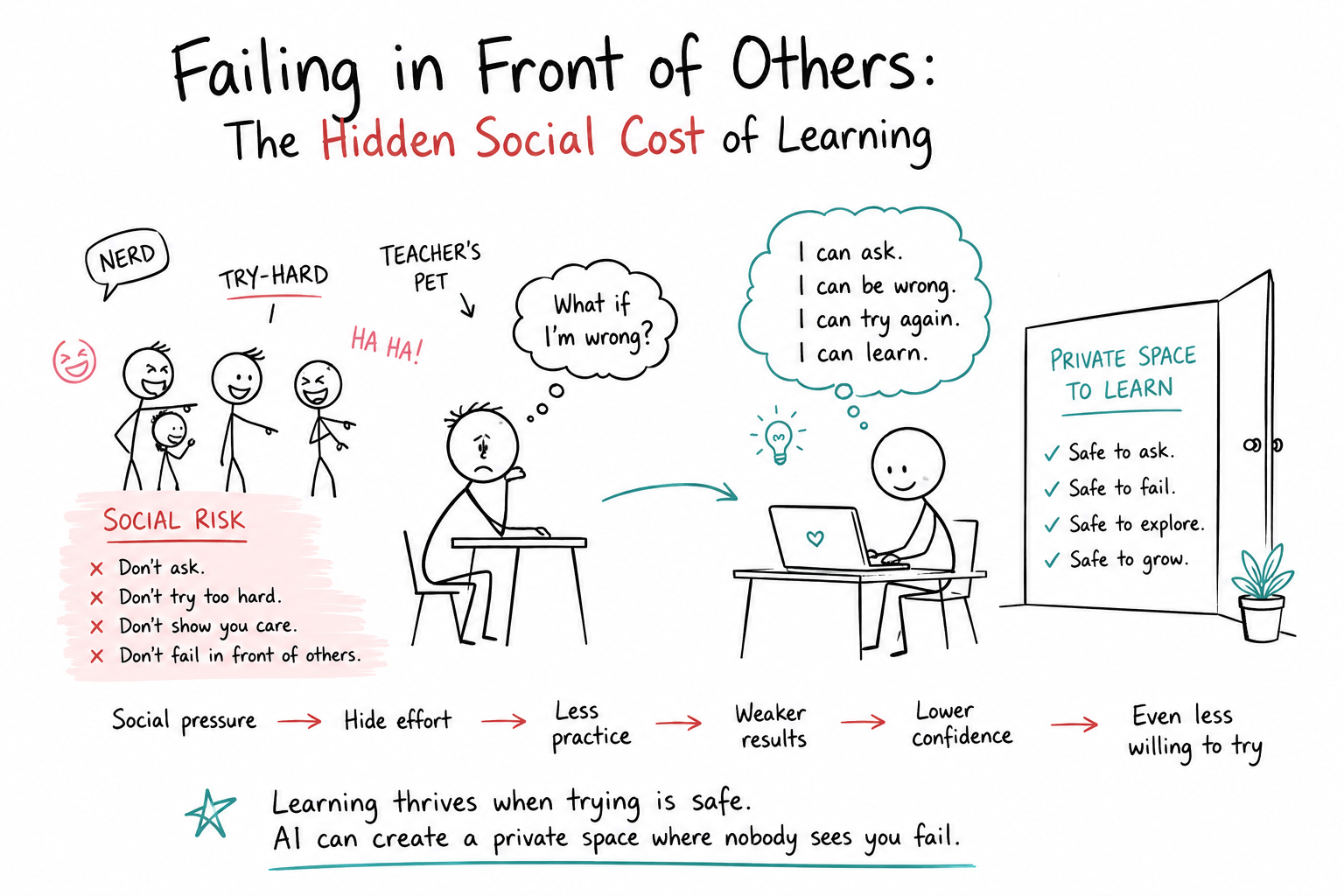
Social pressure → hiding effort → less practice → weaker performance → lower confidence → even less willingness to try.
Eventually something particularly damaging can happen.
A behavior that originally began as social protection can become part of the student's identity.
“I don't really study” becomes:
“I'm not a studying person.”
“I don't understand math” becomes:
“I'm bad at math.”
“I don't want to answer in class” becomes:
“I'm just not good at school.”
The student may eventually forget that the process started with something much smaller.
They learned that not trying was safer.
The desired state and the actual system
This is why thinking about the desired state of education matters.
Suppose we define the desired state like this:
A student is curious, willing to try, comfortable making mistakes and motivated to improve.
That sounds reasonable.
But then we need to ask a harder question:
Does the environment actually reward the behaviors required to reach that state?
Because saying that students should be curious is not enough.
Telling students that mistakes are part of learning is not enough.
Putting “growth mindset” posters on classroom walls is not enough.
If asking a basic question creates embarrassment, students will stop asking.
If visible effort lowers social status, students will hide effort.
If failure happens publicly, some students will avoid difficult tasks altogether.
You cannot evaluate an educational system only by what it tells students to do.
You also have to examine what the environment quietly teaches them to avoid.
And then AI changes something important
Most conversations about AI in education focus on productivity.
AI can explain things.
Generate exercises.
Give feedback.
Personalize learning.
Answer questions.
All of that matters.
But there may be another effect that receives far less attention.
AI can create a private space for learning.
A student can ask an AI:
“What does this word mean?”
And then ask again.
“I still don't understand.”
And again.
“Explain it like I'm 12.”
And again.
“Give me an easier example.”
And again.
“Can we start from the beginning?”
Nobody laughs.
Nobody rolls their eyes.
Nobody knows that the student needed the concept explained six times.
The student can get an answer wrong twenty times without twenty classmates watching.
That changes the social economics of learning.
Private failure is incredibly powerful
Learning requires failure.
Not catastrophic failure.
Small failure.
You try.
You are wrong.
You adjust.
You try again.
Traditional classrooms cannot always make that process private.
A teacher asks a question in front of thirty students.
One student answers.
The answer is wrong.
Even if the teacher reacts perfectly, the student has still experienced a public social event.
Some students don't care.
Others care enormously.
With an AI tutor, the same student can make hundreds of mistakes privately.
There is no audience.
That matters because it can separate two things that have traditionally been difficult to separate:
learning performance and social performance.
The student no longer needs to perform competence while trying to develop competence.
They can simply learn.
AI does not remove social pressure
This does not mean AI magically solves the social dynamics of schools.
It doesn't.
Students still belong to groups.
Classroom culture still matters.
Teachers still matter enormously.
Human relationships remain fundamental to education.
And AI introduces its own risks: dependency, incorrect information, shortcutting thinking and using the technology to avoid learning rather than support it.
But dismissing AI as merely an easier way to complete homework misses something potentially transformative.
For some students, AI may provide something that schools have historically struggled to provide at scale:
a psychologically and socially low-risk place to be confused.
That is not a small thing.
Confusion is where learning often begins.
Maybe students don't always need more motivation
When a student appears uninterested in learning, the obvious conclusion is:
“They need to become more motivated.”
Sometimes that is true.
But perhaps we should ask another question first:
What does this student's environment make it socially expensive to do?
Maybe the student is curious.
Maybe they would like to understand.
Maybe they would even work hard.
But somewhere along the way, they learned that visible effort comes with a social price.
If that is true, the solution is not simply telling students to care more.
We need environments where caring is safe.
Where questions are safe.
Where mistakes are safe.
Where trying is normal.
And where students have opportunities to practice without constantly performing for an audience.
Where APUOPE fits
AI could become one part of that environment.
Not because machines are better than teachers.
Not because students should learn alone.
But because sometimes the first thing a learner needs is surprisingly simple:
A place where nobody is watching them fail.
APUOPE is designed to give students space to work with their own learning material, discover gaps in understanding and practice those weak areas without needing to perform competence for an audience.
The goal is not to hide failure.
The goal is to make failure useful.
When a weakness is discovered privately, it can become a mastery opportunity before it ever becomes a public failure.
Final thoughts
Schools ask students to learn.
But learning requires vulnerability.
It requires saying:
I don't know yet.
It requires trying before you are good.
It requires making mistakes before you understand.
And if the social environment makes those behaviors expensive, students may protect themselves by avoiding the exact behaviors learning requires.
AI will not solve that problem by itself.
But it can provide something valuable:
A private place to ask. A private place to practice. A private place to fail.
And sometimes that may be exactly what a learner needs before they are ready to succeed in front of everyone else.